Ask that question about a home anywhere else in Southwest Florida and the answer is mostly arithmetic: get a contractor's estimate, compare it to what a renovated home would sell for, decide if the math pencils out. On Fort Myers Beach, the arithmetic isn't the hard part. The hard part is a rule that can turn a modest repair into a legal requirement to rebuild the entire structure from the pilings up.
That rule has already rewritten one of the island's best-known addresses, and it's quietly shaping every listing decision being made on Estero Boulevard right now.
The Cottages That Weren't Worth Fixing
A few days after Hurricane Ian hit in September 2022, Dennis and Lisa Greenspon posted an update on the website for their rental property, the Cottages of Paradise Point. The community they'd built over two decades on Estero Boulevard, twelve lots running from the road to the Gulf, was gone. They wrote that they wouldn't be rebuilding.
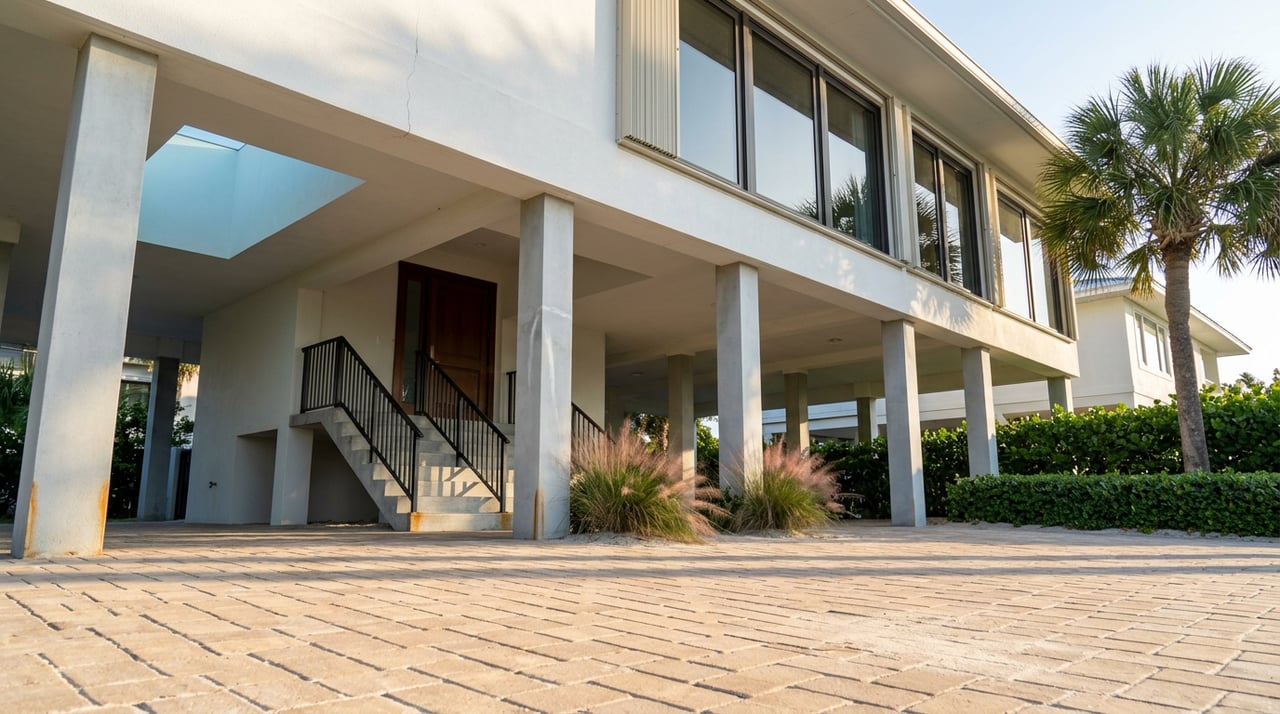
By January 2026, a little over three years after the storm, construction crews broke ground on the first new cottage on that same land. The difference between what stood there before and what's going up now is the whole story. The original cottages were built in the 1960s on wood pilings, low to the ground, which was standard practice at the time but falls well short of what current flood codes require. The new cottages are rising 15 feet above the ground on concrete pilings, engineered to withstand 160 mile per hour winds. Marvin Homes, the Fort Myers builder handling the project for the Greenspons, has already started on a 2,143 square foot cottage and has two more in the pipeline, including one with a pool built beneath the house. According to reporting in the Business Observer, the finished homes will start at roughly $2.6 million and will be sold rather than rented, a shift from the vacation-rental model the property ran for years.
That price jump isn't just inflation or nicer finishes. It's the cost of compliance layered on top of the cost of construction, and it explains why so few owners on this stretch of the island are choosing to patch what's left of an older structure instead of starting over.
The Rule Behind the Rebuilding Boom
The mechanism at work is FEMA's Substantial Improvement and Substantial Damage regulation, known locally as the 50 percent rule. The Town of Fort Myers Beach spells it out plainly on its own site: if the cost of repairing or improving a non-conforming structure in a flood zone reaches 50 percent of that structure's market value, the entire building has to be brought up to current flood elevation standards, not just the portion being worked on.
A few details make this rule stickier than it sounds:
- The 50 percent threshold is cumulative over a five year window. A new roof this year and a kitchen remodel two years from now both count toward the same total.
- Market value is calculated using the Lee County Property Appraiser's tax roll figure or an independent appraisal, not the price a buyer paid or hopes to sell for.
- Enclosed space below the base flood elevation that's larger than 299 square feet counts as habitable floor area under FEMA and NFIP guidelines, which limits how much of an older ground-level layout can be preserved as-is.
- Costs that don't count toward the 50 percent include plans, surveys, permits, sidewalks, pools, screens, sheds, gazebos and fences, which is a narrower list of exemptions than most owners expect.
For a home built to 1960s or 1970s standards, on a barrier island that took a direct hit from Ian's storm surge, that math rarely stays under the line. Once storm repairs alone approach half the structure's value, a full-compliance rebuild often becomes the only legal path forward, regardless of what the owner would prefer.
Six New Homes Where Cottages Used to Stand
The same pattern is visible a few blocks north, on the 700 block of Estero Boulevard, where four different builders are putting up six new homes on land that held a cluster of beachfront cottages for decades before Ian wiped them out. One of the homes, built by Royal Corinthian Homes, is being poured almost entirely in concrete, sitting on 30 pilings and standing nearly 20 feet high with full Gulf views. Two others are modular builds from Idyll Construction. Local Realtors Alex King and Marc Taglieri, who are marketing the remaining lots, say the buyer pool driving this activity is coming increasingly from outside the immediate area, including Fort Lauderdale, Miami Beach, Boca Raton, and a growing number of buyers from New Jersey and New York.
Taglieri, describing the shift toward all-concrete construction, put it this way:
"It's becoming more common and desirable if it fits an owner's budget."
That single line captures the real segmentation happening in this market. Buyers with the budget for full compliance are building new, at 15 feet or higher above grade, and skipping the 50 percent question entirely. Buyers hoping to save money on an older, lower structure are the ones who need to understand exactly how little renovation room that structure actually has left.
The Insurance Bill Tells the Same Story
The 50 percent rule doesn't just govern what you can build. It shapes what you'll pay every year afterward. A newly elevated home meeting current Base Flood Elevation plus one foot of freeboard carries meaningfully lower flood insurance premiums than an older structure sitting at or below grade, because the exposure to storm surge is fundamentally different. That gap in carrying cost is part of why the island's average home value has softened even as new construction pushes ahead. Zillow's tracking put the average home value on Fort Myers Beach at $495,294 as of late June 2026, down 5.2 percent from the year before, a decline that likely reflects buyers pricing in the future cost of bringing older, non-conforming stock into compliance rather than treating those homes as simple fixer-uppers.
Inventory on the island has settled into a more balanced range as well, with recent tracking putting supply at roughly 4.9 months, meaning buyers today have more room to slow down, request documentation, and negotiate than they did in the years immediately after Ian.
Before You Write an Offer on an Older Cottage
If you're looking at a ground-level or low-elevation home on Fort Myers Beach, the listing price is only half the picture. Before making an offer, ask for:
- A current elevation certificate, showing the structure's height relative to Base Flood Elevation
- Any Repair/Improvement Cost Forms already on file with the Town's Community Development Department, which track cumulative work against the 50 percent threshold
- A binding flood insurance quote based on the home's actual current elevation, not an estimate
- Permit history for the property going back five years, since that window is what the Town uses to calculate cumulative improvement costs
None of this makes an older cottage a bad purchase. It makes it a different kind of purchase than a newly elevated home, one where the renovation budget you're planning may not legally exist once storm damage and past permits are added together.
A Few Questions Worth Asking Directly
Does insurance-funded storm repair count toward the 50 percent threshold the same as a discretionary renovation? Yes. The Town's calculation is based on the cumulative cost of work performed, regardless of whether that work was paid for out of pocket or through an insurance claim.
Does buying a home that's already been elevated to current code protect you from facing this rule again? Largely, yes. A structure that already meets Base Flood Elevation plus one foot of freeboard is considered conforming, which means future repairs and improvements are evaluated differently than they would be for a non-conforming, below-grade structure.
Can a buyer check how much of a property's 50 percent allowance has already been used? The Town requires a Repair/Improvement Cost Form to be filed with any permit application on a non-conforming structure. Asking the seller or the Town's Community Development Department for that permit history, rather than relying on a verbal assurance, is the only reliable way to know where a specific address stands.
Fort Myers Beach is rebuilding into something more resilient, and the pier project moving toward its targeted 2027 completion is one visible marker of that progress. But the more important marker for a buyer is quieter: whether the home you're considering has already crossed the line that requires full compliance, or whether it's one storm repair away from it. That's the number worth knowing before you fall for the price.
If you're weighing an older cottage against new construction on Fort Myers Beach, or trying to figure out what a specific address's elevation and permit history actually mean for your budget, Jennifer Rosenwald can help you pull the documentation together before you write an offer. Let's Connect.