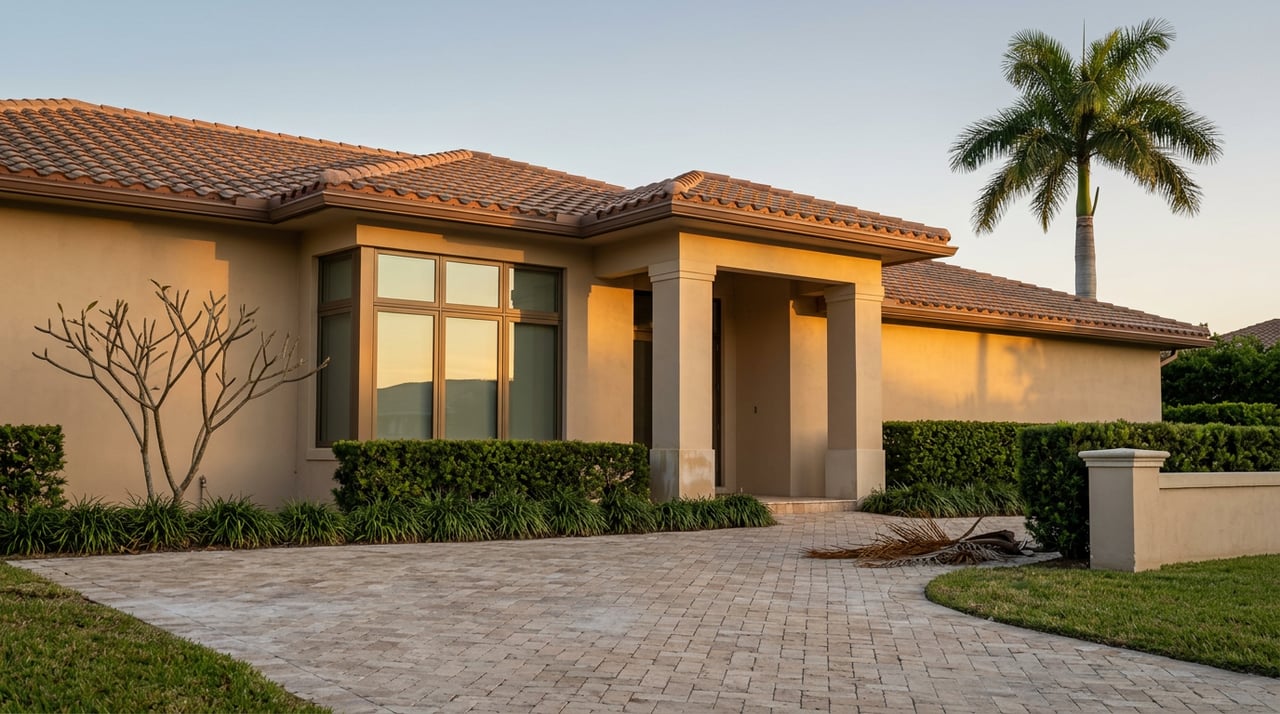
A homeowner in Sun Village Estates lists her house this fall, a few months after Bonita Springs Utilities finished running gravity sewer mains down her street. The septic tank in her front yard is gone. The paperwork says the lot is now connected to central sewer. From the buyer's side, that reads like a straightforward upgrade: no more tank pumping, no more drain field to worry about, one less system that can fail on a rainy August afternoon.
For a buyer, a key detail is how the connection was paid for, because that affects what the buyer may inherit.
The Program Behind the New Pipe in the Street
Bonita Springs Utilities, a member-owned cooperative founded by local citizens in 1970, has been working with the City of Bonita Springs to convert specific legacy septic neighborhoods to central sewer. Two projects with names attached are underway: Sun Village Estates and Lakes of Sans Souci. Both involve the same scope of work: gravity sewer mains, manholes, service lines, cleanouts, and in Sun Village's case, a dedicated pump station. Existing septic systems get abandoned once the connection is live.
The stated reason is water quality, not aesthetics. BSU has said publicly that nutrient loading from septic drain fields is a factor in declining water quality in the area, including in the Imperial River. Removing septic tanks from these neighborhoods is framed as part of a broader effort to protect that waterway. The state has stepped in to help fund it, with a grant covering half of the construction cost, and BSU and the city are contributing additional funds to bring the homeowner's share down further.
That is the good part of the story, and it is genuinely good. What comes next is the part that matters more if you are buying or selling on one of these streets right now.
How the ANC Fee Is Paid
Once a property connects, the homeowner owes an Aid-to-New-Construction fee, what BSU calls the ANC Fee. It is priced against the treatment plant capacity the home will use, and BSU is explicit that the amount can change over time and lives in the utility's wastewater tariff rather than in any fixed public number. A buyer should confirm the applicable amount rather than rely on a single published figure.
Here is where the real decision gets made. A property owner facing the ANC Fee has two paths. Pay it outright, or take BSU up on a courtesy financing option: 4 percent interest over 30 years. To use that option, the owner has to execute a utility service lien on the property. BSU records that lien in the public record specifically so a future buyer knows there's an unpaid balance attached to the house.
Two homes on the same street, connected by the same crew during the same month, can carry two completely different financial pictures depending on which path the previous owner chose. One has a clean title with no wastewater debt. The other has a recorded lien and a monthly obligation running for up to three decades.
What Actually Transfers at Closing
BSU's own FAQ answers the question a lot of buyers don't think to ask: does the remaining balance follow the house? Yes. The payment obligation may transfer to a new owner when that owner applies for service. The seller does not necessarily settle the fee before closing. If the lien is unpaid, it rides with the property, and the incoming owner steps into whatever term and balance remain on that 30-year clock.
That single fact is the thing worth building a purchase strategy around. A buyer looking at a home in Sun Village Estates or Lakes of Sans Souci should ask a specific question before writing an offer: is there a recorded utility service lien tied to this parcel, and if so, what's the outstanding balance and remaining term? That is a title search question and a BSU account question, not a guess based on how nice the yard looks now that the septic tank is gone.
For a seller, the calculation runs the other way. Paying off the ANC Fee before listing removes a line item that could otherwise complicate a buyer's underwriting or simply make the home a harder sell next to a comparable property with no lien attached. Leaving the balance in place is possible under the transfer option, but the seller should expect the conversation to come up during due diligence, not after closing.
Connection Isn't Optional Once the Main Is Live
There's a second detail that matters for anyone who assumes they can simply decline to hook up. BSU's FAQ says state law and city ordinance require connection within one year once wastewater service becomes available to a property. A homeowner can't leave a functioning septic system in place indefinitely once the sewer main reaches the curb. That timeline is worth knowing if you're buying into one of these neighborhoods mid-project, because it sets a hard date by which the ANC Fee decision has to be made, whether that decision belongs to you or the person you bought the house from.
Sun Village Estates began mobilization and preliminary construction in July 2025, and BSU has said construction on projects like this typically runs about a year. That puts the neighborhood at or past its expected completion window as of this fall, which means most properties there have likely already gone through the connection and the ANC Fee decision rather than facing it later. Lakes of Sans Souci is on a similar one-year construction timeline. Anyone touring homes in either neighborhood right now should confirm the actual status of a specific street with BSU's construction hotline rather than assuming from the calendar, because "the project finished last spring" and "my house is connected and the fee is settled" are two very different things to verify before writing an offer.
What This Means for a Purchase Contract
None of this makes a home in these neighborhoods a bad buy. Getting off septic and onto centralized sewer is a genuine improvement to a property, and the state and city have absorbed a meaningful share of the cost specifically to make that transition easier for homeowners. The point is that the improvement and the financing decision are two separate facts, and only one of them shows up automatically when you pull a listing.
Before writing an offer in Sun Village Estates or Lakes of Sans Souci, ask for confirmation of the property's BSU account status, whether the ANC Fee has been paid in full or financed, and if financed, the outstanding balance and remaining term on the utility service lien. Before listing a home in either neighborhood, decide early whether paying off that balance before you go to market is worth it, since a buyer's lender may ask the same questions you would.
A Few Questions Worth Asking Directly
Does the utility service lien show up in a standard title search? BSU records it in the public record specifically so it's discoverable, which means a title company doing its job should catch it. Ask your closing agent to confirm it's been checked, rather than assuming.
Can a buyer pay off the lien early after taking title? BSU's FAQ confirms additional principal payments are allowed, so a new owner who inherits the obligation isn't locked into the full 30-year term if they'd rather clear it sooner.
What happens if a homeowner skips the utility service lien paperwork entirely? According to BSU, a property owner who doesn't complete the lien and release forms becomes responsible for arranging and paying for their own connection, outside of the financed option altogether.
Is this happening anywhere else in Bonita Springs beyond these two neighborhoods? These are the two named projects with published details as of now. If you're looking at a different older, septic-served pocket of the city, it's worth asking BSU directly whether that street is on a future list.
If you're weighing a purchase or a sale in one of these neighborhoods and want a clear read on where a specific property stands, Jennifer Rosenwald can help you pull the right questions together before you're deep into a contract.
This article is general information, not legal, tax or financial advice. Consult a qualified professional about your situation.